The Evolution of the High-Capacity Family Transport
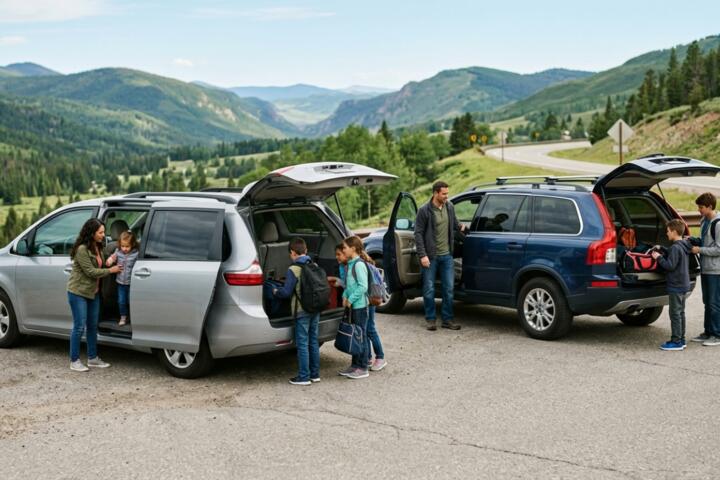
The market for large family vehicles has bifurcated into two distinct philosophies: the efficiency-first minivan and the lifestyle-oriented SUV. For decades, the minivan was the undisputed king of school runs, but the modern three-row SUV has closed the gap with advanced unibody platforms that mimic car-like handling. According to 2024 market data from organizations like Cox Automotive, while SUVs hold a dominant market share, minivans retain the highest "loyalty rates" among parents with three or more children under the age of 12.
In practice, the choice often boils down to "Step-in Height" and "Second-row Configuration." For example, a family using three car seats across a single row faces a much easier task in a Honda Odyssey than in a Chevrolet Tahoe, despite the Tahoe being physically larger. This is due to the lower floor pan and wider cabin aperture of the van. Conversely, for families in mountainous regions like Colorado or Vermont, the ground clearance of a Jeep Grand Wagoneer offers a level of seasonal reliability that even an All-Wheel Drive (AWD) minivan cannot match.
Statistical trends show that modern SUVs now offer towing capacities reaching up to 8,000–9,000 lbs, whereas minivans are almost universally capped at 3,500 lbs. If your family lifestyle includes a travel trailer or a boat, the mechanical decision is often made for you before you even step onto the dealership lot.
Critical Pain Points in Large Vehicle Ownership
The most common mistake families make is "buying for the outlier." They purchase a massive 4WD SUV because they might go camping once a year, while suffering the 15 MPG fuel economy and difficult parking logistics the other 364 days. This mismatch leads to significant "buyer's remorse" within the first 18 months of ownership. The physical strain of lifting heavy toddlers into a high-clearance SUV, versus the effortless entry of a low-slung van, is a daily friction point that many underestimate during a 15-minute test drive.
Another major oversight is the "Cargo Behind the Third Row" metric. Many mid-sized three-row SUVs, such as the Toyota Highlander, offer very little storage space when all seats are occupied. Families often find they can fit six people but zero strollers or grocery bags. This forces the purchase of expensive roof racks or hitch-mounted carriers, which further degrade fuel efficiency and increase the vehicle's height, making some parking garages inaccessible.
Finally, there is the "Third-Row Penalty." In many SUVs, the rearmost seats are designed for occasional use by small children. The floor is often raised to accommodate the rear axle, forcing passengers into a "knees-to-chest" seating position. This becomes a significant issue as children enter their teenage years and require legitimate legroom, making the vehicle obsolete for the family's needs sooner than planned.
Tactical Recommendations for Maximum Utility
Prioritize Sliding Doors for Urban Environments
Sliding doors are the single most underrated feature in automotive design. They allow children to exit the vehicle in tight parking spots without the risk of "dinging" adjacent cars. This is not just about convenience; it is a safety feature that prevents children from squeezing through half-opened doors into traffic. In a Chrysler Pacifica, the hands-free sliding door sensors are a lifesaver when you are carrying a sleeping toddler and three bags of groceries.
Analyze the Seat-Folding Mechanism Efficiency
If you frequently switch between hauling people and hauling cargo, look for "Stow 'n Go" seating or power-folding third rows. Manually removing heavy bench seats is a relic of the 1990s. Modern systems in the Kia Carnival or Hyundai Palisade allow you to transition from a 7-passenger configuration to a flat-floor cargo hold in under 60 seconds. This versatility is essential for families who visit big-box retailers like Costco or IKEA frequently.
Evaluate the LATCH System Integration
Don't just look at the number of seats; look at the number of LATCH (Lower Anchors and Tethers for Children) points. A vehicle might have eight seats but only two sets of anchors in the second row. For a family with three children in car seats, this creates a logistical nightmare. The Volkswagen Atlas is a standout here, as it allows a car seat to remain installed in the second row while still tilting the seat forward to allow access to the third row.
Calculate Real-World Fuel Costs for Daily Commutes
The fuel economy gap between a hybrid minivan and a traditional V8 SUV is staggering. A Toyota Sienna Hybrid achieves an EPA-estimated 36 MPG combined, while a large SUV might struggle to hit 18 MPG. Over 15,000 miles a year, with gas at $3.50 per gallon, the Sienna owner saves roughly $1,500 annually. Over a 5-year ownership period, that is $7,500—enough to cover a significant portion of the vehicle's depreciation.
Demand Dedicated Rear Climate Control and Tech
Large cabins take longer to heat and cool. Ensure the vehicle has a "Tri-Zone" climate system with vents in the ceiling or pillars for the third row, not just on the floor. Additionally, look for "Passenger Talk" features (found in the Honda Odyssey) that use a microphone to broadcast the driver's voice to the rear speakers. This reduces the need to turn around and shout, keeping the driver's eyes on the road.
Assess the Ground Clearance vs. Ease of Entry
If you don't live in an area with heavy snow or unpaved roads, high ground clearance is a liability. It raises the center of gravity, making the vehicle more prone to "body roll" in corners, and it makes loading gear onto the roof much harder. A minivan’s lower step-in height (typically around 14-15 inches) is much safer for elderly grandparents and young children than the 20+ inch climb into a Ford Expedition.
Real-World Family Transitions
The Miller family, a household of six (two adults, four children aged 2 to 10), initially purchased a full-sized luxury SUV for its "status" and AWD capabilities. However, they found that the daily school drop-off took 10 minutes longer because the younger children couldn't climb in themselves, and the oldest child was cramped in the third row. After 12 months, they traded for a Toyota Sienna AWD. The result was a 40% reduction in monthly fuel spend and a significant decrease in "morning friction," as the kids could operate the power sliding doors themselves.
Conversely, the Thompson family lives on a gravel road in the Pacific Northwest and frequently hauls a 5,000 lb horse trailer. They opted for a Chevrolet Suburban. While they pay more at the pump, the vehicle's heavy-duty frame and high-range 4WD system prevent them from getting stranded during the winter months. For them, the SUV wasn't a fashion choice; it was a mechanical necessity for their specific geography. Their "win" was choosing the extended wheelbase version, which ensured they didn't lose cargo space when the third row was up.
Direct Comparison: Minivans vs. Three-Row SUVs
| Feature | Modern Minivan (e.g., Sienna, Odyssey) | Large 3-Row SUV (e.g., Tahoe, Expedition) | Mid-Size 3-Row SUV (e.g., Pilot, Telluride) |
|---|---|---|---|
| Entry/Exit | Best (Low floor, sliding doors) | Difficult (High step-in) | Moderate (Narrow door opening) |
| Max Cargo Space | Highest (Up to 140+ cu. ft.) | High (Up to 120+ cu. ft.) | Low/Moderate (70-85 cu. ft.) |
| Fuel Economy | Excellent (Up to 36 MPG Hybrid) | Poor (15-20 MPG) | Average (20-25 MPG) |
| Towing Capacity | Limited (3,500 lbs) | Superior (8,000+ lbs) | Moderate (5,000 lbs) |
| Drive System | FWD or AWD | RWD, 4WD with Low Range | FWD or AWD |
Common Pitfalls to Avoid During Purchase
One frequent error is ignoring the "Center Console" design in the second row. Many SUVs offer "Captain’s Chairs," which create a pass-through to the back. While comfortable, this reduces your total seating capacity to seven. If you have a fourth child or want to bring a friend along, you lose that flexibility. Always check if the center console is removable; some models like the Honda Odyssey have a "Magic Slide" seat that can be added or removed as needed.
Avoid the "Base Engine" on large SUVs. A fully loaded vehicle with seven passengers and luggage weighs significantly more than its curb weight suggests. A base four-cylinder or underpowered V6 will struggle on highway on-ramps, leading to higher engine wear and surprisingly poor fuel economy because the engine is constantly under high load. Opting for the turbo-diesel or hybrid powertrain often provides the torque necessary for a smoother, safer family driving experience.
Frequently Asked Questions
Which is safer for a large family: a minivan or an SUV?
Both perform well in crash tests, but they offer different types of safety. Minivans generally have a lower center of gravity, making them less likely to roll over during emergency maneuvers. SUVs offer a "mass advantage" in multi-vehicle collisions but are more prone to tip-overs due to their height. Look for Top Safety Pick+ ratings from the IIHS for any model you consider.
Can you fit three car seats across in a mid-size SUV?
It is difficult but possible in specific models like the Volkswagen Atlas or Audi Q7. However, it often requires "slim" car seats (like the Diono Radian series). Minivans almost always accommodate three-across seating much better due to their flatter seat cushions and wider interior dimensions.
Is AWD necessary for family vehicles?
Unless you live in an area with frequent unplowed snow or steep unpaved grades, Front-Wheel Drive (FWD) with a good set of winter tires is usually sufficient. AWD adds weight, cost, and complexity. However, if you do need it, models like the Toyota Sienna and Chrysler Pacifica now offer AWD, erasing one of the SUV's historical advantages.
Do SUVs hold their value better than minivans?
Generally, yes. Large SUVs like the Toyota Sequoia or Chevrolet Tahoe tend to have slower depreciation rates because of their utility and towing capabilities. However, the Toyota Sienna is a notable exception, often retaining a massive percentage of its value due to the high demand for its hybrid powertrain.
What is the "Golden Rule" for third-row access?
The "Golden Rule" is to never buy a vehicle without testing the third-row access while car seats are installed in the second row. Many "easy-access" seats are disabled once a car seat is strapped in, forcing passengers to climb over the seats or enter through the trunk.
Author’s Insight
After a decade of reviewing family vehicles and raising my own kids, I’ve realized that the "cool factor" of an SUV disappears the third time you have to climb into a cramped backseat to buckle a toddler in 90-degree heat. For most families living in suburban environments, the minivan is the superior tool—it is a "living room on wheels." My practical advice: rent your top choice for a weekend on Turo before buying. A test drive around the block won't reveal the frustrations of a poorly designed cup holder or a laggy infotainment system that the kids will be using every day.
Conclusion
Selecting the best three-row vehicle requires a cold-eyed assessment of your daily habits versus your occasional needs. If you prioritize fuel efficiency, ease of entry, and maximum interior volume, the modern minivan remains the undisputed champion of family logistics. If your lifestyle demands heavy towing, off-road capability, or you simply prefer the elevated seating position, a full-sized SUV is a powerful, albeit more expensive, alternative. Focus on LATCH points, real-world cargo space, and the actual ease of third-row access to ensure your investment serves your family for years to come.