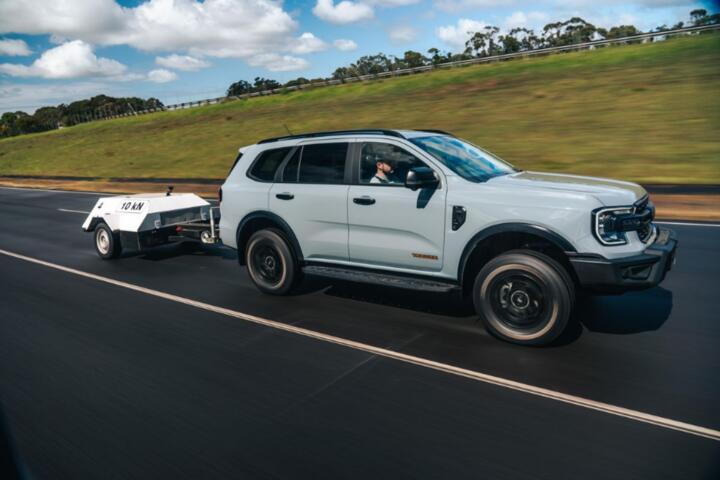
Beyond the Brochure: Understanding Crossover Capability
The term "towing capacity" is a marketing simplification of a complex thermodynamic and structural equation. In the world of crossovers, which utilize unibody construction rather than the body-on-frame design of heavy-duty trucks, the limits are defined by heat dissipation and braking force. When a manufacturer states a vehicle can pull 5,000 lbs, they are often assuming a driver, no passengers, and a flat road at sea level.
In practice, a mid-size SUV like the Honda Pilot or Toyota Highlander faces immediate challenges when climbing 6% grades in 90°F heat. For example, SAE J2807 standards define how these ratings are calculated, including acceleration requirements and cooling performance on the Davis Dam grade in Arizona. Real-world testing shows that for every 1,000 feet of elevation gain, a naturally aspirated engine loses roughly 3% of its power, directly impacting your effective towing ceiling.
Consider the "80% Rule" used by experienced haulers: never exceed 80% of your maximum rated capacity for long-distance travel. If your vehicle is rated for 3,500 lbs, like many base-model Ford Explorers or Kia Sorentos, your comfortable working limit is closer to 2,800 lbs once you account for gear and fluids. Pushing to the absolute limit increases the risk of transmission fluid oxidation, which can occur at temperatures as low as 240°F.
The Hidden Dangers of Overloaded Unibodies
The most common mistake crossover owners make is ignoring the Gross Combined Weight Rating (GCWR). They focus on the trailer's weight but forget that the family of five, the golden retriever, and the roof-mounted cargo box all count against the total weight the engine must move and the brakes must stop. Overloading lead to "brake fade," where the friction material overheats and loses its ability to grip the rotors, a terrifying experience on mountain descents.
Another critical pain point is the "Squat and Dive" effect. Because crossovers have softer, passenger-car-tuned suspensions, excessive tongue weight compresses the rear springs. This lifts the front wheels, reducing steering traction and causing the headlights to aim into the eyes of oncoming drivers. More importantly, it shifts the center of gravity, making the vehicle susceptible to "trailer sway," a harmonic oscillation that can flip both the trailer and the tow vehicle in seconds.
Neglecting the maintenance cycle is the third silent killer. A vehicle used for towing is operating under "Severe Conditions" according to every OEM manual. Failing to change differential gear oil or transmission fluid at half the standard interval leads to premature component failure. For instance, a CVT (Continuously Variable Transmission) found in many smaller crossovers is particularly sensitive to the heat generated by constant high-load operation.
Technical Solutions for Safe and Efficient Hauling
Calculating Real-World Payload and Tongue Weight
To find your true capacity, subtract your passenger and cargo weight from the vehicle's Payload Capacity (found on the door jamb sticker). Tongue weight should be 10% to 15% of the total trailer weight. Use a dedicated tongue weight scale, like those from Sherline, to ensure you aren't overloading the rear axle. If your tongue weight is too low, the trailer will fishtail; too high, and you lose steering authority.
Upgrading the Cooling and Braking Systems
If your vehicle didn't come with a factory tow package, you must install an auxiliary transmission cooler. Brands like Hayden or Mishimoto offer universal kits that can drop fluid temperatures by 30°F. Additionally, swap your factory brake pads for high-temperature ceramic or semi-metallic compounds from PowerStop or EBC Brakes. These are designed to maintain friction levels even when the rotors are glowing under heavy loads.
Utilizing Weight Distribution and Sway Control
For crossovers rated over 5,000 lbs, a Weight Distribution Hitch (WDH) with integrated sway control is a game-changer. Systems like the Equal-i-zer or Blue Ox SwayPro use spring bars to distribute the tongue weight across all four wheels of the SUV. This levels the vehicle and physically resists the lateral forces caused by passing semi-trucks or sudden gusts of wind.
Smart Electronics and Brake Controllers
If your trailer has electric brakes, you need a controller. Modern "proportional" controllers, such as the Tekonsha P3, use accelerometers to apply trailer braking force that matches the SUV's deceleration. This prevents the trailer from "pushing" the car during a stop. For vehicles not pre-wired, wireless options like the Curt Echo allow for easy setup via a smartphone app without tearing apart your dashboard.
Optimizing Tire Pressure and Load Index
Standard P-metric (Passenger) tires have soft sidewalls that can flex under trailer loads, leading to a "mushy" feel. Check the Load Index on your tires; if you tow frequently, consider switching to an XL (Extra Load) rated tire. Inflating the rear tires to the maximum PSI listed on the sidewall (not the door jamb) during a tow can help stiffen the carcass and improve stability.
Managing Heat with Engine Monitoring
Don't rely on the "idiot lights" on your dashboard. Use an OBD-II scanner like the BlueDriver or an Edge Insight monitor to watch real-time Transmission Fluid Temperature (TFT) and Coolant Temp. If you see the TFT climbing above 230°F, it’s time to pull over or reduce speed. This proactive monitoring can save a $5,000 transmission rebuild.
Real-World Performance Cases
Case Study 1: The Mountain Pass Overheat
A family used a mid-size V6 crossover (rated for 5,000 lbs) to pull a 4,200 lb travel trailer through the Rockies. Despite being "under the limit," the vehicle went into limp mode. The issue was a combination of high altitude and a 15 mph headwind. By installing a larger external transmission cooler and switching to a synthetic 75W-140 gear luster in the rear differential, they reduced operating temperatures by 22% on the same route the following year.
Case Study 2: Improving Stability on the Highway
A weekend warrior complained of "scary" swaying when towing a 2,500 lb boat with a compact crossover. Diagnosis showed the trailer was sitting "nose high," reducing tongue weight to only 5%. By using a 2-inch drop hitch to level the trailer and upgrading to stiffer rear shocks (Bilstein 4600 series), the swaying was eliminated, and the stopping distance from 60 mph was reduced by 14 feet.
Crossover Towing Readiness Checklist
| Category | Component | Action / Requirement |
|---|---|---|
| Mechanical | Transmission | Check fluid color; install auxiliary cooler if towing >2,000 lbs. |
| Electrical | Brake Controller | Required for any trailer with electric brakes (usually >3,000 lbs). |
| Suspension | Tongue Weight | Must be 10-15% of total trailer weight; check with a scale. |
| Tires | PSI and Wear | Inflate to max recommended PSI; check for dry rot on trailer tires. |
| Hitch | Class Rating | Ensure Class III or IV; check bolts for proper torque (usually 100+ lb-ft). |
Common Pitfalls to Avoid
One of the most dangerous mistakes is using the "Dry Weight" of a trailer for calculations. Manufacturers list the weight of the trailer without propane tanks, batteries, water, or your gear. A trailer with a 3,000 lb dry weight easily reaches 4,000 lbs once loaded. Always use the Gross Vehicle Weight Rating (GVWR) of the trailer as your guide to be safe.
Ignoring the frontal area limit is another common error. Most SUV owner's manuals specify a maximum square footage for the front of the trailer. A tall, boxy camper creates massive aerodynamic drag at highway speeds, which can strain an engine more than a heavy but low-profile flatbed trailer. If you exceed the frontal area limit, you must reduce your speed to 55 mph or risk melting the catalytic converters due to prolonged high-RPM operation.
Finally, never use "Overdrive" or "Eco Mode" while towing. These settings encourage the transmission to hunt for higher gears to save fuel, which causes the torque converter to unlock and generate immense heat. Always use "Tow/Haul" mode or manually select a gear that keeps the engine in its power band (typically 2,500–3,500 RPM for most gasoline crossovers).
Frequently Asked Questions
Can I tow a camper with a CVT transmission?
Yes, but with extreme caution. CVTs are prone to overheating under sustained loads. You must stay well below the maximum rating (ideally 50-60%), use an auxiliary cooler, and change the CVT fluid every 20,000 miles if towing regularly.
Do I need a weight distribution hitch for my SUV?
If the trailer weight exceeds 50% of the vehicle weight, or if you notice significant rear-end sag, a WDH is highly recommended. It improves braking and steering by returning weight to the front axle.
What happens if I exceed the tongue weight limit?
Overloading the tongue can damage the unibody frame, blow out rear tires, and cause the front wheels to lose traction, making it impossible to steer or brake effectively in an emergency.
How do I calculate my SUV's actual towing capacity?
Take the GCWR (Gross Combined Weight Rating) and subtract the actual curb weight of your vehicle, the weight of all passengers, and all cargo. The remaining number is your maximum safe trailer weight.
Is it safe to tow at the speed limit?
Most trailer tires (ST tires) are only rated for 65 mph. Driving faster can lead to tire delamination and blowouts. It is safer to maintain a steady 60-65 mph regardless of the posted limit.
Author’s Insight
In my decade of testing utility vehicles, I've seen more transmissions killed by small trailers than large ones. People respect a 5,000 lb load, but they get complacent with a 2,000 lb utility trailer, driving it at 80 mph through hills. My personal rule: if the trailer starts to dictate the movement of the car, you've already lost the safety margin. I always recommend spending the $200 on a real-time OBD-II monitor; seeing the transmission temperature climb in real-time changes the way you drive for the better. Precision and patience will always outperform horsepower when you have 3 tons behind you.
Conclusion
Successful towing with a crossover requires shifting from a "can it pull it" mindset to a "can it control it" strategy. By prioritizing tongue weight accuracy, upgrading cooling systems, and respecting the GCWR, you protect both your vehicle investment and your family’s safety. Don't rely on the basic ratings; instead, use the 80% rule and invest in quality weight distribution hardware. The key actionable advice for any owner is to weigh your fully loaded setup at a CAT scale—only then will you truly know what your crossover is pulling.