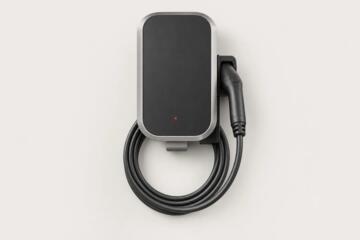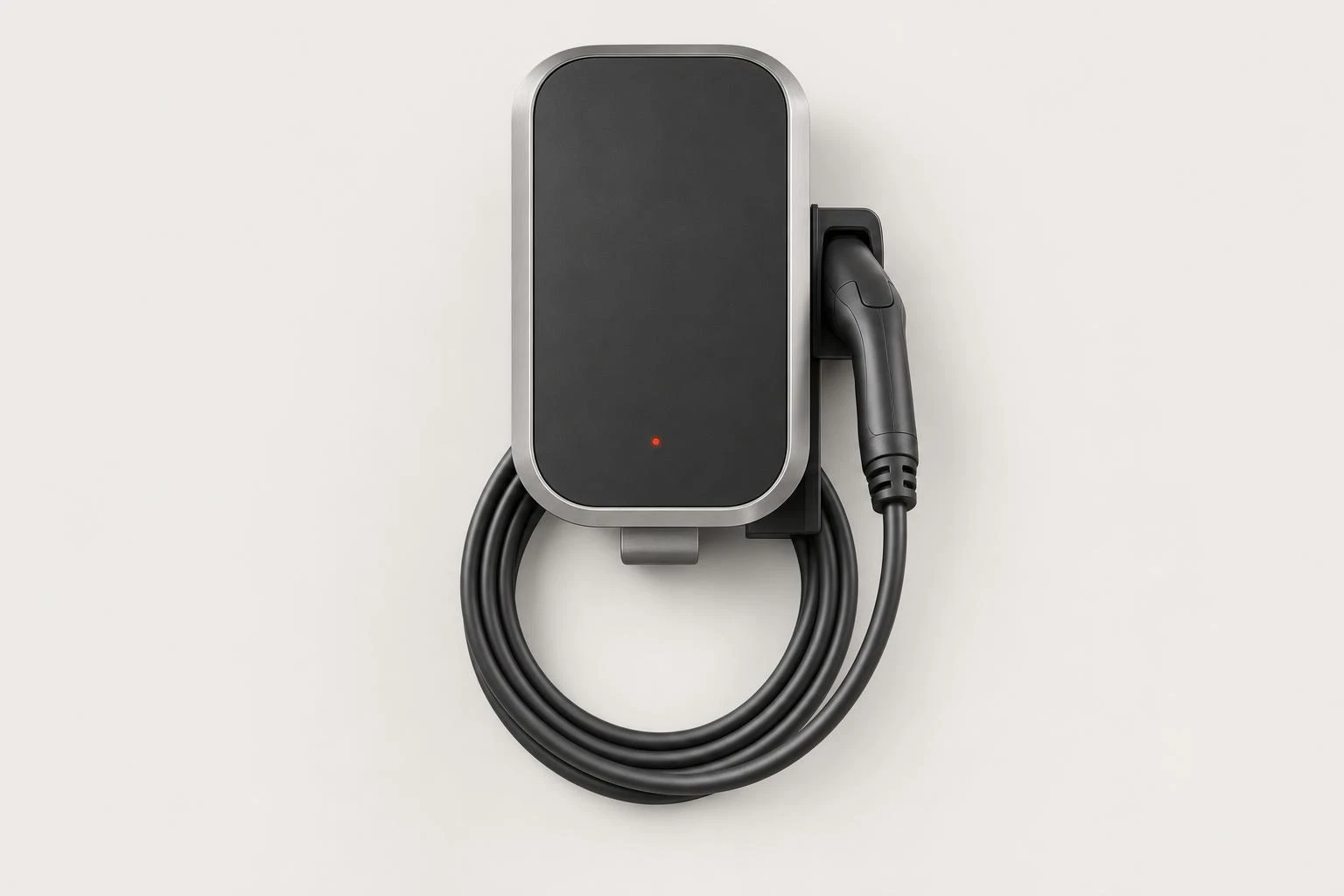
Charging time is the energy the battery needs divided by the power that reaches it. For a typical 60 kWh battery, that is roughly 7 hours from 10% to 90% on a home Level 2 charger, more than 25 hours on a standard 120 V outlet, and about 25 minutes from 10% to 80% at a steady 100 kW on a DC fast charger, though real sessions run longer because charging power drops as the battery fills.
Key takeaways
- The Department of Energy lists about 5 miles of range per hour for Level 1, about 25 miles per hour for Level 2, and about 100 to 200+ miles per 30 minutes for DC fast charging.
- The car's own internal charger capacity is one of the factors that sets AC charging time, so a more powerful wall unit does not always shorten the session.
- DC fast charging power varies by vehicle and battery state of charge, and fast-charge times are usually quoted to 80%, not 100%.
- A typical 30-amp, 7.2 kW home Level 2 unit needs a dedicated 40-amp circuit under the National Electrical Code, higher-power units need a larger circuit, and local permits may be required.
- SAE has published J3400, the standard based on Tesla's NACS connector, but most non-Tesla EVs built through 2024 use a CCS1 port, so connector compatibility still matters on the road.
Charging levels and typical speeds
The Department of Energy's Alternative Fuels Data Center (AFDC) groups charging into three types. Level 1 and Level 2 deliver alternating current (AC), which the car converts to direct current (DC) for the battery. DC fast charging, also called Level 3, supplies DC directly. The units are simple: power is measured in kilowatts (kW) and battery size in kilowatt-hours (kWh), and time is kWh divided by kW.
| Type | Typical power | Range added, per AFDC |
|---|---|---|
| Level 1 (120 V AC) | About 1.9 kW | About 5 miles per hour |
| Level 2 (240 V residential, 208 V commercial) | 2.9 to 19.2 kW; residential units typically up to 7.2 kW | About 25 miles per hour |
| DC fast charging | Up to 500 kW; actual power varies by vehicle and state of charge | About 100 to 200+ miles per 30 minutes |
These are the figures on the AFDC electric charging infrastructure page. They are rounded rules of thumb. The Level 1 figure assumes 1.9 kW of charging power, while the AFDC does not state the power behind the Level 2 figure, so the range column is approximate and not a conversion formula for any one car.
What limits speed at home
The circuit, the charger and the car
The AFDC lists several factors that affect charge time, including how depleted the battery is, the charging equipment, and the vehicle's internal charger capacity. That internal part is the onboard charger, which, per the AFDC description of how all-electric cars work, converts incoming AC power to DC for the traction battery and communicates with the charging equipment while monitoring battery voltage, current, temperature and state of charge.
Because the AC power is converted inside the car, the slowest link in the chain sets the pace. A 19.2 kW Level 2 unit paired with a car whose onboard charger accepts 7.2 kW would be limited by the car in the illustrative arithmetic below. The AFDC does not publish a table of onboard charger ratings, so the figure for a specific model comes from its owner's manual or manufacturer specifications.
Home installation
For Level 1, the AFDC page on charging at home says owners can use the cordset provided with the vehicle, and overnight Level 1 charging needs no extra installation provided a power outlet on a dedicated branch circuit is available near the parking spot.
For Level 2, the same page says an electrician can tell homeowners whether the home has enough electrical capacity, and if not, a qualified electrician can add circuits. It adds that appropriate permits may be required from local building and permitting authorities. The AFDC infrastructure page states that most residential Level 2 chargers operate at up to 30 amps, delivering 7.2 kW, and that these units require a dedicated 40-amp circuit to comply with Article 625 of the National Electrical Code (NFPA 70). Higher-power units need a larger circuit: a 40-amp, 240 V circuit carries at most 9.6 kW (40 × 240 watts), well short of the 19.2 kW top of the Level 2 range, so an electrician sizes the circuit to the unit chosen. Rules for permits and inspections are set locally, so the local building department is the place to confirm what applies.
Utility pricing also affects the cost of a home session. The AFDC notes that some utilities offer residential time-of-use rates, and that actual residential electricity costs depend on the equipment and the time of day.
Worked charging-time examples
The formula below gives a first estimate. The efficiency term accounts for energy lost in the charger and cables; the DOE's fueleconomy.gov EV technology page says battery charging efficiency can vary but is often 84% to 93%.
hours = (battery_kWh × (end_SOC − start_SOC)) / (power_kW × efficiency)
- battery_kWh is the usable battery capacity.
- start_SOC, end_SOC are the starting and ending state of charge (the battery's fill level), as fractions.
- power_kW is the lowest of the circuit or station output and the car's maximum accepted power.
- efficiency is the share of grid energy that reaches the battery.
Illustrative example: a 60 kWh battery charged from 10% to 90% needs 60 × (0.90 − 0.10) = 48 kWh. The hours below were computed with Python using AFDC power figures; the 93% and 84% columns use the ends of the fueleconomy.gov efficiency range.
| Power | No losses | 93% efficient | 84% efficient |
|---|---|---|---|
| 1.9 kW (Level 1) | 25.3 hours | 27.2 hours | 30.1 hours |
| 7.2 kW (typical residential Level 2) | 6.7 hours | 7.2 hours | 7.9 hours |
| 19.2 kW (top of the Level 2 range) | 2.5 hours | 2.7 hours | 3.0 hours |
Two things follow from the numbers. A car that accepts only 7.2 kW takes the 7.2 kW times even at a 19.2 kW station, so the last row applies only to a vehicle that can accept that power. And an overnight window of about 10 hours covers the Level 2 case with room to spare but not the Level 1 case, which would need roughly 27 hours for this much energy.
Daily driving is a different case. The AFDC infrastructure page says 8 hours of charging at 120 V can replenish about 40 miles of electric range for a mid-size EV. At the AFDC's Level 2 rule of thumb of about 25 miles per hour, the same 40 miles takes about 1.6 hours (40 ÷ 25). That is why a standard outlet can cover modest daily mileage while failing to refill a deeply discharged battery in one night. Actual consumption varies by vehicle, speed and weather, so a car's own rating gives a better estimate.
Why DC fast charging slows down
The AFDC says DC fast charging can reach up to 500 kW, but that actual charging power varies by vehicle and battery state of charge. A single quoted maximum therefore describes the charger's limit, not the average over a session. The fueleconomy.gov page frames fast charging the same way, noting that even a fast charge to 80% capacity can take 30 minutes. Published fast-charge times usually stop at 80% rather than a full fill, which fits the AFDC's point that power depends on state of charge; the DOE pages do not give a power curve for the last 20%.
Illustrative example: moving a 60 kWh battery from 10% to 80% needs 60 × 0.70 = 42 kWh. At a constant 150 kW that would take 16.8 minutes, at 100 kW 25.2 minutes, and at 50 kW 50.4 minutes. Real sessions do not hold one power level, so measured times are longer than a calculation at the peak power, and the gap grows when the vehicle lowers its accepted power. This simple version also ignores conversion losses.
Other influences on fast-charging speed, such as battery temperature and preconditioning (warming the battery before arrival), differ by manufacturer and model. The DOE pages opened for this article do not quantify them, so the owner's manual or the manufacturer's support page for a specific vehicle is the right source for those details.
Connectors and the J3400 transition
What is on the road now
On the AFDC page, Level 1 and Level 2 use the J1772 connector, and DC fast charging uses CCS (J1772 combo), CHAdeMO or J3400 (NACS). The Joint Office J3400 page notes that CCS1 adds two DC pins below the J1772 layout and says non-Tesla EVs produced through 2024 continue to have a CCS1 port; the AFDC still lists CHAdeMO, which it calls a common DC fast connector among Japanese automakers, so not every model uses CCS1. The same page says the NACS design that J3400 is based on handles AC Level 1 and Level 2 as well as DC charging, and works with J1772 through an adapter.
One federal rule covers connectors at some public stations. Under 23 CFR 680.106(c), each DC fast charging port must be able to charge any CCS-compliant vehicle and must have at least one permanently attached CCS Type 1 connector. Section 680.102 limits the rule to National Electric Vehicle Infrastructure (NEVI) Formula Program projects and publicly accessible chargers funded under Title 23 of the US Code, so privately funded stations are not bound by it.
Where J3400 stands
SAE published a technical information report in December 2023. Its catalog entry lists J3400_202409, North American Charging System (NACS) for Electric Vehicles, as a Recommended Practice revised September 30, 2024. A companion document, J3400/2_202505, a Technical Standard published May 27, 2025, defines the dimensions of the connector and inlet. In a September 2024 news item, the Joint Office reported that SAE's EV Coupler Task Force had voted to establish the Recommended Practice; its connector page dates that vote to August 2024.
For vehicles, the Joint Office page says most manufacturers committed to incorporate the J3400 connector beginning in 2025. Adapters remain part of the picture: a September 2025 Porsche Cars North America release says all new model year 2026 Taycan and Macan Electric vehicles include a NACS DC adapter at no additional fee. Because plug type, adapter approval and network access are decided vehicle by vehicle, the manufacturer's page for the exact model year is the authority on which stations it can use. The AFDC page still describes J3400 vehicles as currently only Tesla, so its connector notes lag the transition.
Frequently asked questions
Can an EV charge from a regular household outlet?
Yes. Level 1 uses a 120 V outlet and the cordset provided with the vehicle, as described by the AFDC. The AFDC says overnight charging this way requires a power outlet on a dedicated branch circuit near the parking location.
Does a home Level 2 charger need a permit?
The AFDC says appropriate permits may be required from local building and permitting authorities, and in many areas a site installation plan must be approved before installation. Requirements differ by locality, so the local building department can confirm them. The AFDC also says an electrician can assess whether the home has adequate capacity.
Is DC fast charging the same as Level 3?
Yes. The AFDC states that DC fast charging is also referred to as Level 3 charging. It uses CCS, CHAdeMO or J3400 connectors, depending on the vehicle.
Why do fast-charging claims stop at 80%?
The AFDC says charging power varies by vehicle and by battery state of charge. The fueleconomy.gov page says even a fast charge to 80% capacity can take 30 minutes. The DOE pages do not publish a time for the last 20%, so how much longer a full fill takes depends on the vehicle.
Will a faster wall charger always shorten charging time?
No. The AFDC lists the vehicle's internal charger capacity among the factors that affect charge time, and the onboard charger is the part that converts AC to DC. If the car accepts less power than the wall unit offers, the car sets the limit.
A checklist before choosing a setup
- Find the vehicle's battery capacity and its maximum AC and DC charging power in the owner's manual or manufacturer specifications.
- Estimate daily energy use, then divide by the available power with the formula above to see whether Level 1 covers it.
- For Level 2 at home, ask an electrician about panel capacity and the dedicated circuit size the chosen unit needs (40 amps for a typical 30-amp, 7.2 kW unit), and ask the local building department about permits.
- Check the connector on the car and on the stations along regular routes, and confirm adapter requirements with the manufacturer.
- Treat time-of-use rates from the utility as part of the plan if a plan is available.
This article is general education, not electrical or installation advice. Figures are rounded DOE values and illustrative calculations, so a specific vehicle and charger will differ.
Sources
- US Department of Energy AFDC, electric charging infrastructure
- US Department of Energy AFDC, charging at home
- US Department of Energy AFDC, how do all-electric cars work
- US Department of Energy, fueleconomy.gov EV technology
- Joint Office of Energy and Transportation, SAE J3400 charging connector
- Joint Office of Energy and Transportation, J3400 standard practice news
- SAE Mobilus, J3400_202409
- SAE Mobilus, J3400/2_202505
- eCFR, 23 CFR 680.106, NEVI charging infrastructure standards
- Porsche Newsroom USA, NACS adapter and Supercharger access