Overview: The Invisible Fluid at High Velocity
Aerodynamics is the study of how gases interact with moving bodies. At low speeds, air is negligible; however, because aerodynamic drag increases with the square of speed, its impact becomes the primary obstacle for vehicles traveling over 80 km/h (50 mph). A car moving at 200 km/h is essentially fighting a thick "soup" of air molecules that wants to either lift the vehicle off the ground or hold it back via suction.
In practice, we focus on the lift coefficient (CL) and the drag coefficient (CD). A typical modern sedan might have a CD of 0.26, while a Formula 1 car—prioritizing grip over raw speed—might have a CD as high as 0.70. This trade-off is the core of automotive design. For example, the Bugatti Chiron must actively retract its wing to reach its 400+ km/h top speed because the very downforce that keeps it safe in corners acts as a physical brake at its limit.
One striking fact: at 300 km/h, a high-performance GT3 race car can generate downforce equivalent to 2.5 times its own weight. This allows it to theoretically drive upside down on the ceiling of a tunnel, provided the speed is maintained.
The Bernoulli Principle and Pressure Differentials
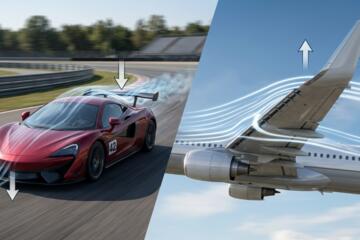
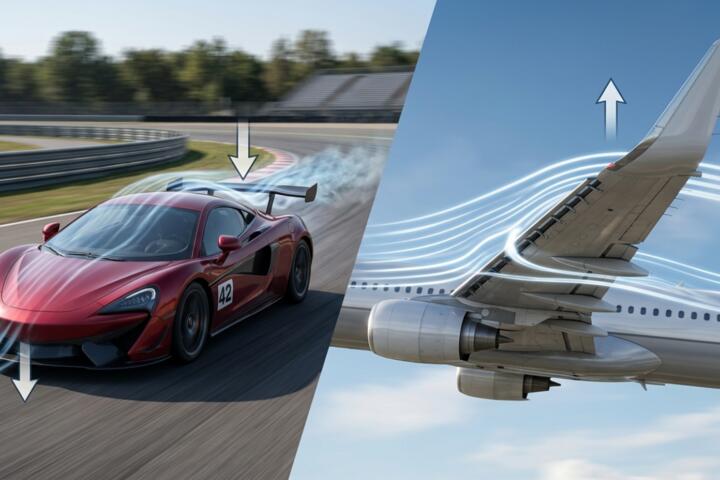
Airflow works on the principle that fast-moving air creates low pressure, while slow-moving air creates high pressure. A wing (or airfoil) is shaped so that air travels faster across one side than the other. On a plane, this creates lift; on a car, we flip the wing upside down to create "negative lift" or downforce, pushing the tires into the pavement for enhanced friction.
Boundary Layer Separation and Wake Turbulence
The "wake" is the chaotic, low-pressure air left behind a moving vehicle. This area acts like a vacuum, pulling the car backward. Spoilers are often used not to create downforce, but to "spoil" unfavorable air patterns and smooth out this wake, significantly reducing fuel consumption in commercial trucks and long-distance cruisers.
Ground Effect and Venturi Tunnels
Modern supercars like the Aston Martin Valkyrie utilize the "ground effect." By shaping the underbody like an inverted wing, air is accelerated through narrow tunnels. This creates a massive low-pressure zone that literally sucks the car to the road without the massive drag penalty associated with large rear wings.
The Critical Role of Aspect Ratio
The efficiency of a wing is heavily dependent on its length-to-width ratio. Longer, narrower wings (high aspect ratio) are generally more efficient at producing downforce with less drag. This is why you see wide, sweeping wings on time-attack cars; they need every ounce of grip to navigate tight technical circuits where top speed is secondary.
Active Aerodynamics: Real-Time Adaptation
Static parts are always a compromise. Companies like Porsche and McLaren use active systems that adjust the angle of attack (AoA) based on speed and braking force. Under heavy braking, a rear wing might tilt to 70 degrees, acting as an "air brake" and shifting the center of pressure forward to keep the car level.
The Hidden Costs of Improper Aerodynamic Tuning
The most common mistake in aftermarket tuning is the "bigger is better" fallacy. Installing a massive rear wing without a corresponding front splitter creates an aerodynamic imbalance. At high speeds, the rear is pushed down while the front lifts, resulting in dangerous understeer and a "light" steering feel that can lead to catastrophic loss of control.
Furthermore, many enthusiasts install spoilers at angles that are too aggressive. When the angle of attack exceeds approximately 15 degrees, the airflow "stalls"—it separates from the surface entirely. This results in a massive increase in drag with zero additional downforce, effectively turning your performance part into a parachute.
In real-world scenarios, a poorly designed aero kit can increase fuel consumption by up to 15% and decrease top speed by 20-30 km/h, all while providing no measurable improvement in cornering grip. This is particularly prevalent in "bolt-on" culture where aesthetics take precedence over CFD (Computational Fluid Dynamics) testing.
Solutions and Recommendations for Optimized Airflow
To achieve a balanced aerodynamic setup, you must treat the vehicle as a single system. Start with the front. A front splitter is essential because it creates a high-pressure zone on top and a low-pressure zone underneath. This keeps the nose planted and ensures the air reaching the rest of the car is "clean" and laminar.
For the rear, use a spoiler to manage the air's exit point. Unlike wings, which are designed to have air flow on both sides, spoilers are extensions of the bodywork. They are highly effective for reducing lift in street cars. If you are building a track car, use a "Gurney Flap"—a small vertical tab on the trailing edge of a wing. This tiny addition can increase downforce by 10-15% with a negligible increase in drag.
Data-driven tuning is now accessible via tools like Ansys Discovery or AirShaper. By running a virtual wind tunnel test, you can see exactly where pressure builds up. In practice, adding "canards" (small dive planes) to the front bumper can help move air around the front wheels, which are a major source of turbulent drag. Even a 5mm adjustment in ride height can change the effectiveness of a rear diffuser by 30%, as the "seal" between the car and the road is vital for the Venturi effect.
Performance Gains: Real-World Case Studies
Case Study 1: Amateur Time-Attack Team A privateer team racing a modified Honda Civic noticed high-speed instability at a local circuit. They initially added a 1600mm rear wing, which caused the car to understeer off the track in fast bends. After consulting an aero specialist, they added a 3-inch front splitter and blocked off unnecessary grill openings. Result: Front-end lift was reduced by 40%, and lap times dropped by 2.4 seconds purely through improved high-speed balance.
Case Study 2: Logistics Fleet Optimization A regional shipping company equipped 50 heavy-duty trucks with rear "tail" fairings and side skirts. These components were designed to reduce the low-pressure wake behind the trailer. Result: The fleet saw a documented 6.5% increase in fuel efficiency over 12 months, saving approximately $180,000 in diesel costs.
Aerodynamic Component Comparison
| Component | Primary Function | Speed Threshold | Drag Impact | Best For |
|---|---|---|---|---|
| Spoiler | Reduces lift / Smooths wake | 60+ km/h | Low/Negative | Street cars, Fuel efficiency |
| Rear Wing | Generates Downforce | 100+ km/h | High | Track performance, Racing |
| Front Splitter | Balances Front Grip | 80+ km/h | Medium | Reducing high-speed understeer |
| Diffuser | Underbody Pressure Recovery | 120+ km/h | Low | High-speed stability |
| Vortex Generators | Delays flow separation | 90+ km/h | Very Low | Maintaining wing efficiency |
Common Pitfalls in Surface Design
One of the most frequent errors is neglecting the "rake" of the car. Rake is the angle of the car's floor relative to the ground. If the rear of the car is too high, air enters the underbody but cannot exit fast enough, creating "parachuting" lift. Always ensure your suspension setup complements your aero; a nose-down attitude usually helps the front splitter work more effectively.
Another mistake is using "open" wheels. Wheels are responsible for nearly 25% of a car's total aerodynamic drag. Using "turbofan" style covers or smoothing the wheel arches can yield more performance than a massive wing. If you see air exiting wildly from the wheel wells, it’s a sign of lost energy. Adding vents to the top of the fenders (louvers) can bleed off this high-pressure air, reducing lift and improving cooling for the brakes simultaneously.
FAQ: Frequently Asked Questions
Do spoilers actually work on street cars?
Most factory spoilers on standard sedans are aesthetic. However, on performance-oriented models, they are tuned to reduce the lift that naturally occurs at highway speeds, making the car feel more "planted" and reducing fuel consumption by streamlining the air's exit.
Is there a difference between a wing and a spoiler?
Yes. A wing is an airfoil that stands away from the body to let air pass both above and below it, creating downforce. A spoiler is attached directly to the body and its job is to "spoil" or redirect the air to reduce drag or lift.
How does rain affect aerodynamics?
Water is much denser than air. In heavy rain, the "effective" shape of your car changes as a film of water builds up. Furthermore, aerodynamic devices like diffusers can become less efficient as they have to move a heavier air-water mix, which is why race cars often change their aero balance in the wet.
Can aerodynamics improve my electric vehicle's range?
Absolutely. For EVs, aerodynamics is the single most important factor for highway range. Reducing the CD from 0.30 to 0.20 can increase range by up to 15% at highway speeds because the motor doesn't have to work as hard to push through the air.
What is "DRS" and how does it work?
DRS (Drag Reduction System) is an active aero feature where a portion of the rear wing flattens out. This reduces the surface area facing the wind, cutting drag and allowing for much higher top speeds on straightaways, typically used in professional racing to facilitate overtaking.
Author’s Insight: A Practical Perspective
In my years testing various track configurations, I have found that the most "aggressive" looking setup is rarely the fastest. I once worked on a project where we removed a prominent rear wing and replaced it with a subtle ducktail spoiler and better underbody shielding; the car gained 8 km/h on the straight and felt significantly more stable in high-speed transitions. My advice is simple: always prioritize "clean" air over "more" air. A small, well-placed flap is always superior to a large, turbulent wing that ruins the airflow for everything behind it.
Conclusion
Aerodynamics is a game of management, not just force. By understanding that wings generate downforce at the cost of drag, and spoilers manage air exit to improve efficiency, you can make informed decisions about vehicle modifications. Focus on maintaining a balance between the front and rear of the vehicle, minimize turbulent wake through smooth transitions, and use data-backed tools to validate your changes. For the best results, start by cleaning up the airflow under the car before adding prominent wings on top. Proper aerodynamic integration is the most cost-effective way to unlock hidden performance and efficiency in any vehicle.