A weight-distribution hitch (WD hitch) is needed when the vehicle maker's towing guide or owner's manual says so, which usually happens when the loaded trailer or its tongue weight passes the limit for a plain ball hitch. For several 2026 models that limit sits at 5,000 pounds of trailer weight, and for the Ford Expedition it sits at 7,000. The bars on the hitch move some of the trailer's downward load forward; they do not change what the trailer weighs.
Key takeaways
- A WD hitch uses spring bars to shift part of the tongue load forward onto the tow vehicle's front axle and rearward onto the trailer's axles, according to Chevrolet's 2026 trailering guide.
- Receiver ratings differ with and without the bars: Ford lists a 5,000-lb trailer and 500-lb tongue limit for a weight-carrying F-150 hitch, against 13,500 lb and 1,400 lb with weight distribution on the equipped version.
- The bars do not raise the vehicle's own trailer rating. Ford's receiver charts say receiver capacities may exceed the vehicle's maximum loaded trailer weight, and its Super Duty notes state the towing values are the same for both hitch types.
- Weight distribution and sway control are different jobs. Chevrolet's guide asks for both on some vehicles, and CURT says a sway control can be used with a WD hitch or alone.
- Thresholds vary by maker and model, and some Ford models list no weight-distribution setting at all, so the owner's manual for the exact vehicle decides.
What the hitch does to the load
A ball hitch sits behind the rear axle, so the trailer's tongue weight (the downward force the coupler puts on the hitch ball) pushes the back of the tow vehicle down. Ford's guide warns that too much tongue load can press the vehicle down at the rear until the front wheels lift enough to severely reduce traction, steering response and braking. Too little tongue load causes the opposite problem: Ford says it can reduce rear-wheel traction and cause instability.
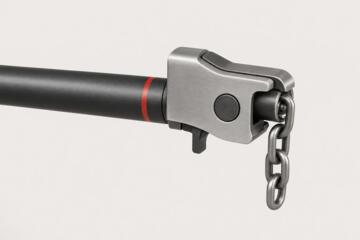
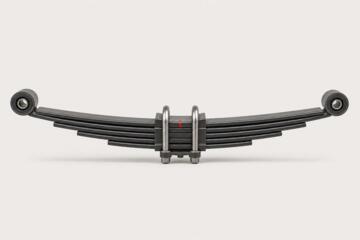
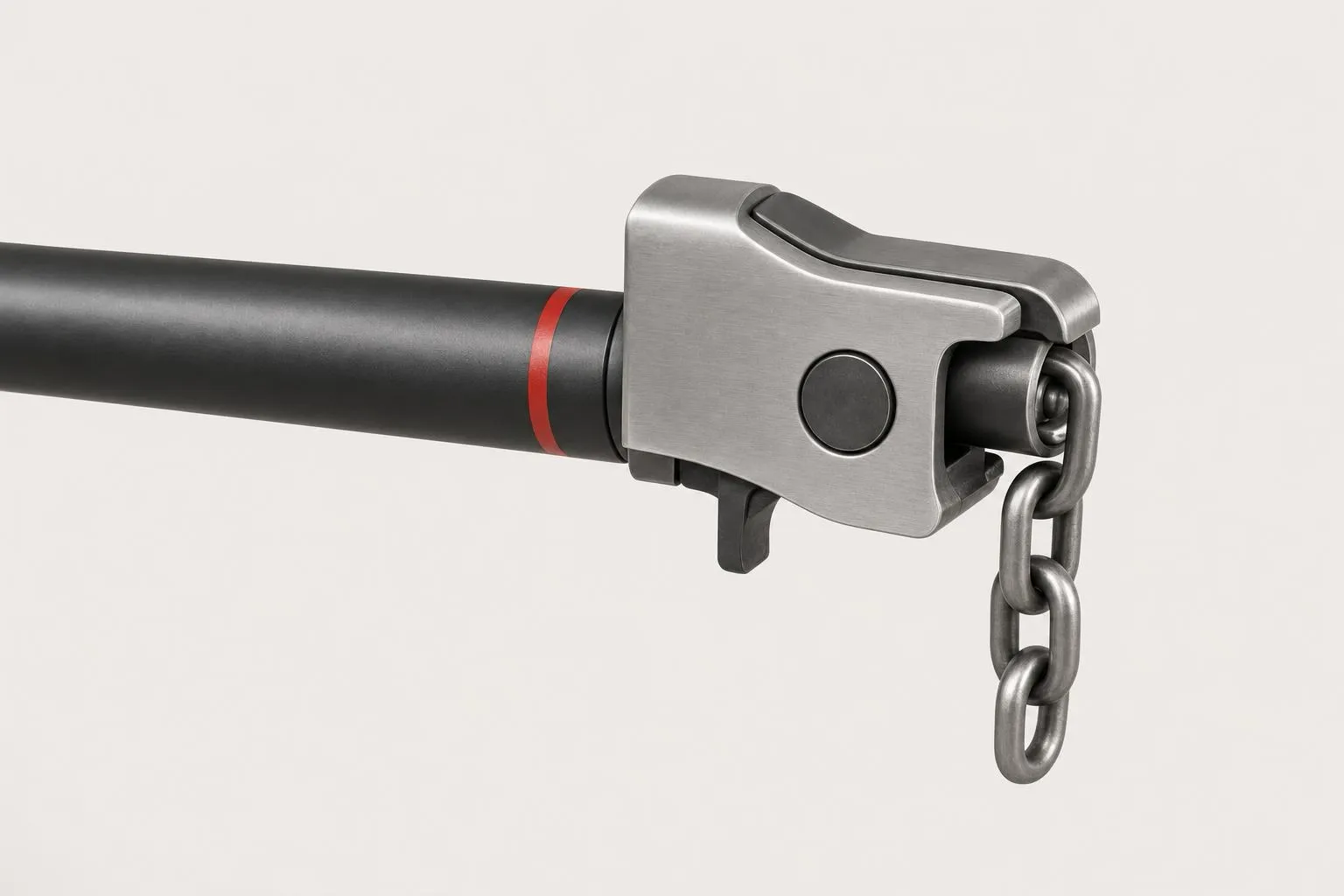
A WD hitch works through a receiver and a pair of spring bars. Ford describes the bars as being tightened with chains so they bend upward, which lifts some weight from the rear wheels and transfers it to the other wheels of the vehicle and trailer. Chevrolet's 2026 trailering guide puts it as shifting some hitch weight forward onto the front axle and rearward to the trailer's axles.
The key point is that the bars move weight around; they do not remove it. The tow vehicle still carries the tongue weight, the combined vehicle and trailer still has to stay inside its gross combination weight rating, and Ford says that if the vehicle's gross vehicle weight rating or rear axle rating is exceeded, the answer is a larger vehicle or a smaller trailer. The payload and towing limits on the door jamb label are the numbers to check against.
Ratings with and without the bars
Hitch receivers carry their own ratings, separate from the vehicle's trailer rating. Ford says a label on its receivers gives both a weight-carrying and a weight-distributing capacity, and its receiver charts warn that those capacities may exceed the maximum loaded trailer weight for the vehicle. Its Super Duty notes add that trailer towing values are the same for weight-carrying and weight-distributing hitches. In other words, adding bars can raise what the receiver itself can handle, but the vehicle's rating is still the cap.
On some vehicles the bars are also a condition of using the full rating, as on the Expedition, where Ford requires a weight-distributing hitch for trailers over 7,000 lb. CURT, a hitch maker, adds that capacity is limited to the lowest-rated component in the setup, so a bar set rated for 10,000 lb on a receiver or ball rated lower is limited by the lower one.
The ratings below come from the manufacturers' own 2026 documents. They are examples of how the numbers differ by model, not a ranking.
| Source (2026) | Without weight distribution | With weight distribution |
|---|---|---|
| Ford F-150 receiver | 5,000 lb trailer, 500 lb tongue | 13,500 lb trailer, 1,400 lb tongue (requires Tow/Haul Package and Max Tow Axle) |
| Ford Expedition 4x4 (short wheelbase) | 7,000 lb trailer, 700 lb tongue | 9,600 lb trailer, 960 lb tongue |
| Ford Expedition MAX 4x4 (long wheelbase) | 7,000 lb trailer, 700 lb tongue | 9,000 lb trailer, 900 lb tongue |
| Chevrolet Tahoe and Suburban | 5,000 lb trailer, 600 lb tongue | Required, with sway control, for tongue weights above 600 lb; the 5,000-lb weight-carrying maximum also applies |
| Chevrolet Express vans | 5,000 lb trailer, 400 lb tongue | Required, with sway control, for trailer weights above 5,000 lb |
Sources: Ford's 2026 RV and Trailer Towing Guide (F-150 receiver chart), Ford's 2026 Expedition towing information, and Chevrolet's 2026 trailering guide notes under its weight-rating tables. Ford's Expedition notes add that maximum loaded trailer ratings over 7,000 lb require a weight-distributing hitch on both Expedition body lengths.
Both limits in the left column apply at once, and the tongue figure can bind first. On the Express, a 5,000-lb trailer at a 10% tongue share puts 500 lb on the ball, above the 400-lb weight-carrying tongue figure; at 10%, the 400-lb figure is reached by a 4,000-lb trailer.
How the hitch standard fits in
SAE J684 is the SAE standard for trailer couplings, hitches and safety chains. The SAE listing describes it as covering trailers up to 10,000 lb gross vehicle weight rating, mainly with ball-and-socket couplings and hitches; the most recent edition listed is dated May 30, 2014. Ford's guide notes that some industry sources call trailers over 10,000 lb "Class V," which is a label outside that 10,000-lb scope. For a buyer, the class name matters less than the rating labels on the receiver and on the hitch head.
How much tongue weight to expect
Tongue weight is normally a share of the loaded trailer weight. Ford's guide uses 10% for conventional trailers over 2,000 lb, with tongue load not to exceed 200 lb for trailers up to 2,000 lb, and 15% king pin weight for fifth-wheel trailers. Chevrolet's 2026 guide gives 10% to 15% of loaded trailer weight for conventional trailering and notes that some trailer types, especially boat trailers, fall outside that range, in which case the trailer's own manual applies.
The table shows what those shares mean in pounds. These are illustrative trailer weights; the arithmetic is weight multiplied by the share.
| Loaded trailer weight | Tongue weight at 10% | Tongue weight at 15% |
|---|---|---|
| 4,000 lb | 400 lb | 600 lb |
| 5,000 lb | 500 lb | 750 lb |
| 6,000 lb | 600 lb | 900 lb |
| 7,500 lb | 750 lb | 1,125 lb |
| 10,000 lb | 1,000 lb | 1,500 lb |
Illustrative example. A loaded travel trailer weighs 6,000 lb, so at Ford's 10% share the tongue weight is 600 lb, and at Chevrolet's upper 15% it is 900 lb. Against the F-150 receiver figures above, 600 lb is over the 500-lb weight-carrying tongue limit and 6,000 lb is over the 5,000-lb trailer limit. Both fit inside the weight-distributing figures of 1,400 lb and 13,500 lb, provided the truck has the equipment that rating requires and its own trailer rating, payload and axle ratings allow the load.
The same trailer on a Tahoe or Suburban is over Chevrolet's 5,000-lb weight-carrying maximum, so it needs a weight-distributing hitch and sway control whatever its tongue weight. The tongue limit can also bind below 5,000 lb: a 4,500-lb trailer at 15% puts 675 lb on the tongue, over the 600-lb weight-carrying figure.
The only reliable figure is the measured one. Ford says to disconnect the trailer and rest only the tongue on a scale at hitch-ball height; if the weight is above the upper limit, move cargo rearward, and if it is below the lower limit, shift cargo forward. Chevrolet's guide adds that loads too far forward or too far back can create sway at highway speeds and in heavy braking. The vehicle trailer ratings that cap all of these figures come from a separate calculation, and Ford lists SAE J2807 as its method; the steps behind how truck towing ratings are set explain what those numbers assume.
Sway control is a separate job
Weight distribution and sway control are often sold together, which makes them easy to confuse. Weight distribution changes where the trailer's downward load is carried. Sway control resists the trailer's side-to-side motion. Chevrolet's guide lists them as two items ("a weight-distributing hitch and sway control are required" on some vehicles), and CURT's explanation says a sway control attaches between the hitch and the trailer tongue and can be used with a weight-distribution hitch or alone.
Some hitches build the two together. CURT's TruTrack 4P page says its brackets use friction to resist lateral movement, replacing a separate sway control, while CURT's traditional models come with an included sway control unit. A hitch without either does one job only.
Chevrolet's guide says sway often results from improper weight distribution, excessive speed or overloading, and that crosswinds, poor maintenance and road conditions can add to it. A WD hitch addresses only the first of those causes, and only when the trailer itself is loaded correctly. Some vehicles also have an electronic trailer sway control; Chevrolet describes its version as using the stability-control system to apply brakes and reduce engine power if needed.
Setting bars for front-axle load
Front-axle load restoration is the share of the weight that the coupled trailer took off the front axle that the bars put back. Ford's Super Duty notes recommend 50% front axle load restoration when using load bars. Its weight-distribution setup chart lists a 50% correction factor for the F-150, F-150 Raptor, Expedition, F-250 and F-350 Super Duty pickups and Super Duty chassis cabs, and 25% for the F-450 Super Duty pickup with a regular cab (50% with a crew cab).
The method uses fender-height measurements. Ford's setup starts with the trailer loaded as for the trip at a 10% tongue load, both vehicles on level ground, the trailer level or slightly nose down, and the ball set to the coupler's height.
H1 is the height from the ground to the top of the front fender lip, measured directly above the wheel center, with the trailer not connected. H2 is the same measurement with the trailer connected and no bars attached. The bars are then adjusted until the fender reaches a target height.
Target height = H2 - ((H2 - H1) x correction factor)
- H1 is the front fender height before the trailer is connected.
- H2 is the height after connecting the trailer without bars.
- Correction factor is the share Ford lists for the vehicle, 50% for the F-150 and 25% for an F-450 regular cab.
Illustrative example. Take H1 at 37.0 inches and H2 at 39.0 inches. The coupled trailer raised the fender 2.0 inches (39.0 - 37.0). Half of that, 1.0 inch, is the reduction, so the target height is 38.0 inches (39.0 - 1.0).
Ford's own printed example uses 37 and 38 inches and arrives at 37.5 inches by the same steps. Ford also says the trailer should end up level to slightly nose down.
Not every Ford model takes this step. Ford's setup chart lists weight distribution as "Not Required" for the Ranger, Explorer, Bronco, Bronco Sport, Escape, Maverick and Mustang, and "Use Not Recommended" for the Transit. That shows why the owner's manual for the exact vehicle controls, not a general rule.
Frequently asked questions
Does a weight-distribution hitch raise how much my vehicle can tow?
Not by itself. The vehicle's maximum loaded trailer weight, gross vehicle weight rating, rear axle rating and gross combination weight rating stay the same, and CURT notes that capacity is limited to the lowest-rated component. What the bars can change is which of those ratings you are allowed to use: Ford's F-150 receiver is rated for 5,000 lb without them, and the Expedition needs them for any trailer over 7,000 lb.
Does the hitch change the trailer's tongue weight?
The tongue weight comes from how the trailer is loaded, and Ford says to measure it with the trailer disconnected and only the tongue on a scale. The bars change where that load is carried once the trailer is connected, not how heavy the tongue is on the scale. Moving cargo forward or back in the trailer is what changes the tongue weight.
Can a weight-distribution hitch go on any bumper or receiver?
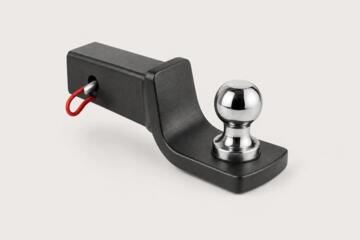
No. Ford says weight-distributing hitch platforms are welded or bolted to the vehicle frame, and Chevrolet's guide tells owners to use a frame-mounted weight-distributing hitch with sway control of the proper size where one is required. Ford also notes that receivers do not include the ball mount or weight-distributing equipment, which the owner must buy to match the trailer and load.
Is a weight-distribution hitch needed for a small trailer?
Usually not. Ford's trailer-class table lists a conventional weight-carrying hitch for trailers up to 2,000 lb, and says a conventional weight-distributing hitch is not required for 2,001 to 5,000 lb trailers unless specified for a particular vehicle. Over 5,000 lb, Ford says most applications require a weight-distributing or fifth-wheel hitch.
What should I do if the trailer starts to sway?
Chevrolet's guide says to hold the steering wheel as steady as possible, release the accelerator without touching the brake pedal, and apply electric trailer brakes by hand if the trailer has them. Once the sway stops, use the vehicle brakes to come to a complete stop. Trying to steer out of sway will likely make it worse, according to the same guide, and Ford's guide warns that when the trailer has electric brakes and a brake controller, applying the tow vehicle's brakes during sway can increase it.
Before you hook up
- Find the vehicle's gross vehicle weight rating and rear axle rating on its certification label, and the receiver's weight-carrying and weight-distributing capacities on the label attached to the receiver.
- Weigh the loaded trailer tongue on a scale and compare it with the share the vehicle maker gives (Ford uses 10% for conventional trailers, Chevrolet 10% to 15%) and with the receiver's tongue limit.
- Check the owner's manual or towing guide for the exact model year to see whether a weight-distributing hitch, sway control or both are required at your trailer weight.
- If bars are used, record H1 and H2, set the target height from the maker's chart, and confirm the trailer sits level to slightly nose down.
- Keep the trailer, hitch head, bars and receiver within the lowest rating of any one of them.
This article is general educational information, not an engineering or safety inspection. Ratings change by model year and configuration, so confirm each figure in the owner's manual and the labels on the vehicle, receiver and trailer, and ask a qualified hitch installer when in doubt.
Sources
- 2026 Ford RV and Trailer Towing Guide (revised 12-19-25), Ford Motor Company
- 2026 Ford Expedition Towing Information, Ford Motor Company
- 2026 Trailering Guide, Chevrolet
- SAE J684, Trailer Couplings, Hitches, and Safety Chains, Automotive Type, SAE International
- Weight distribution learn-more page, CURT Manufacturing
- TruTrack 4P weight distribution hitch product page, CURT Manufacturing
- Weight distribution hitches with sway control, CURT Manufacturing