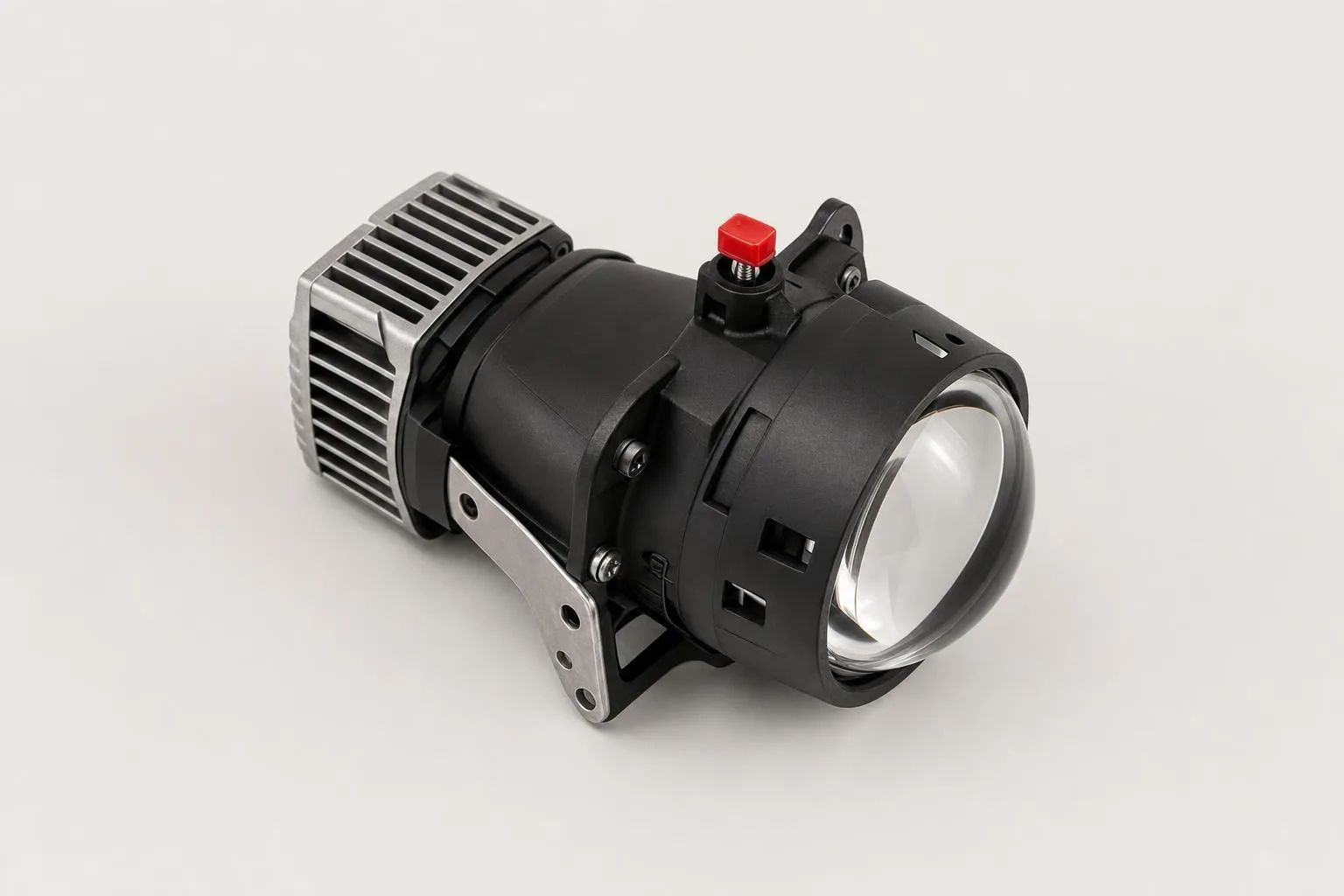
The Insurance Institute for Highway Safety (IIHS) tests headlights because the federal standard checks the lamp on a laboratory bench, not the light it puts on a road. IIHS began rating headlights in 2016 to measure what drivers actually get after dark: how far the light reaches on straight and curved roads, and whether it blinds oncoming traffic. Since then the ratings have become a gate for the group's Top Safety Pick awards.
Key takeaways
- IIHS says government headlight standards rest on laboratory tests that allow huge variation in on-road illumination, so it built a track test that scores the light itself.
- The test measures how far each beam reaches an intensity of at least 5 lux on five approaches, adds demerits for low-beam glare in proportion to how far it exceeds the limits, and gives some credit back for high-beam assist.
- For 2026, both Top Safety Pick and Top Safety Pick+ require acceptable or good headlights, and the IIHS release says all trims must come with them.
- NHTSA's February 2022 rule amended the federal lighting standard to allow adaptive driving beams, which dim only the part of the beam aimed at other drivers.
Why the federal rule fell short
Federal Motor Vehicle Safety Standard (FMVSS) No. 108 governs vehicle lighting. Its headlamp requirements are laboratory photometric tables: a lamp's light output is measured at set points and must fall between minimum and maximum values, with lower beams in one table and upper beams in another, as described in the 2022 Federal Register notice that amended the standard. The standard also sets mounting-height limits and requires headlamps to be aimable, but none of this measures how much light the installed lamps actually put on a road, straight or curved.
IIHS made this point when it released its first ratings on March 30, 2016. It said government headlight standards are based on laboratory tests and allow huge variation in the illumination headlights provide on real roads. It also noted that about half of traffic deaths occur in the dark or at dawn or dusk, and that newer technology such as HID or LED lamps and curve-adaptive systems does not guarantee good performance.
The first batch showed the gap. Among 31 midsize cars from model year 2016, IIHS issued 82 headlight ratings because many models offered more than one system. Only one earned a good rating, and the best system available on each model split into 1 good, 11 acceptable, 9 marginal and 10 poor. On one model, a basic halogen system rated acceptable while the LED option on the same car rated marginal.
What the track test measures
IIHS tests headlights after dark on the track at its Vehicle Research Center in Ruckersville, Virginia. A measuring device records both low beams and high beams on five approaches: a straightaway, gradual curves left and right, and sharp curves left and right. Each approach is driven six times, three with low beams and three with high beams.
The unit of measurement is distance at a fixed light level. Engineers record how far the beam extends at an intensity of at least 5 lux, measured 10 inches above the ground. For scale, IIHS notes that a full moon on a cloudless night lights the ground to about 1 lux, and its 2016 release adds that about 3 lux is typically enough to see low-contrast objects. The current test protocol (Version III, July 2018) sets the gradual curves at a 250-meter radius and the sharp curves at 150 meters, roughly 820 and 490 feet.
Glare is measured separately, for oncoming drivers, from the low beams on each approach. The sensor sits 3 feet 7 inches above the road. Lights are tested as received from the dealer, with no aim adjustment, because few owners adjust aim. A vehicle with several available systems gets a separate rating for each one.
How the demerits become a rating
IIHS compares each system with a hypothetical ideal and assigns demerits where it falls short. Demerits come from low-beam or high-beam illumination that is too short on any approach, and from low-beam glare. The targets are longest on the straightaway (for low beams, on its right edge) and longer on gradual curves than on sharp ones. Low beams count more than high beams, and straightaway readings count more than curve readings.
At the 2016 launch, IIHS described the ideal as lighting at least 5 lux over distances from nearly 200 feet (low beams, sharp curve) to nearly 500 feet (high beams, straightaway). The current protocol keeps those targets: 60 meters (about 197 feet) for low beams on the sharp curves and 150 meters (about 492 feet) for high beams on the straightaway. Low beams earn no demerits on the right edge of the straightaway at 100 meters (about 328 feet) or more. Demerits are summed and rounded: 0 to 10 is good, 11 to 20 acceptable, 21 to 30 marginal and more than 30 poor.
Glare scoring changed after launch. In 2016, excessive glare on any approach capped a rating at marginal. Since Version II of the protocol (November 2016), glare instead adds demerits in proportion to how far it exceeds the limits, with a heavier multiplier on the straightaway (36) than on each curve (6). A system can carry some glare demerits and still rate good or acceptable.
High-beam assist, which switches automatically between high and low beams based on other vehicles, reduces low-beam demerits on any approach where the high beams reach farther than the low beams. The credit is one-third of the difference between the low-beam demerits computed with the low-beam distance and with the high-beam distance. The 2016 rule that withheld this credit on approaches with excessive glare no longer applies.
Headlights and the Top Safety Pick
Headlight scores did not always decide the awards. In 2022, Top Safety Pick+ already required acceptable or good headlights as standard across all trims, while the base Top Safety Pick only needed them to be available on at least one trim level, even as an option. The February 2023 announcement removed that gap: both awards required standard acceptable or good headlights, so a model buyers could still order with poor-rated lights became ineligible.
As of November 2026, the 2026 criteria are below.
| Criterion | Top Safety Pick | Top Safety Pick+ |
|---|---|---|
| Small overlap front test | Good | Good |
| Moderate overlap front test | Good | Good |
| Side test | Good | Good |
| Headlights | Acceptable or good | Acceptable or good |
| Pedestrian front crash prevention | Acceptable or good | Good |
| Vehicle-to-vehicle front crash prevention 2.0 | Not required | Acceptable or good |
IIHS lists the headlight and crash-prevention ratings as applying to standard equipment. Its March 24, 2026 announcement adds that all trims must come with acceptable or good headlights. Because awards use IIHS test results, they sit alongside the government's star program rather than replacing it; the two crash rating systems differ in who runs them and what they score.
The ratings are tied to real crash data. In an October 2021 study of about 44,000 single-vehicle crashes in darkness across 11 states, IIHS found nighttime single-vehicle crash rates about 19% lower for good-rated headlights than for poor-rated ones, 15% lower for acceptable and 10% lower for marginal. This is an association, it comes from the organization that runs the ratings, and it covers model years 2015 to 2020.
Adaptive beams and the 2022 rule
An adaptive driving beam (ADB) headlamp changes its beam pattern to give more light without glaring other drivers. NHTSA's final rule, published February 22, 2022 and effective that day, amended FMVSS No. 108 to let manufacturers certify ADB systems. In automatic mode these systems dim only the parts of the beam aimed at occupied road areas and keep the rest bright. The "auto high-beam" systems already sold in the US only switch between lower and upper beams.
The rule adds its own tests. A vehicle-level track test checks glare using stationary fixtures, including curved-path scenarios. Component-level lab measurements require the dimmed area to meet the existing lower-beam limits and the undimmed area to meet the upper-beam limits. It sets a minimum activation speed of 20 mph and requires a manual override. It does not require manufacturers to offer ADB, and it does not adopt the higher upper-beam maximums permitted in Europe.
Automakers and others petitioned NHTSA to loosen details such as the test fixtures and glare limits. On December 30, 2024, NHTSA denied all petitions for reconsideration and left the requirements unchanged. IIHS says on its headlights topic page, last updated July 2026, that the US rules restrict how these systems function and are likely to limit their effectiveness. IIHS's October 2025 glare study stated that no ADB system was on the US market at the end of 2024. By the July 2026 update of its topic page, IIHS said only a few manufacturers offer ADB in the US, so check a specific model's equipment list rather than assuming it.
Seeing distance versus stopping
A lamp's reach matters because a driver needs to see a hazard early enough to stop. The table below is an illustrative calculation, not an IIHS figure. It assumes a 1.5-second perception-reaction time and braking at 0.7 g on dry pavement, and adds reaction distance to braking distance (speed squared divided by twice the deceleration).
| Speed | Reaction distance | Braking distance | Total to stop |
|---|---|---|---|
| 35 mph | 77 ft | 59 ft | 136 ft |
| 45 mph | 99 ft | 97 ft | 196 ft |
| 55 mph | 121 ft | 144 ft | 265 ft |
| 65 mph | 143 ft | 202 ft | 345 ft |
For comparison, IIHS reported in 2016 that the weakest midsize low beams reached only about 130 feet on the right side of the straightaway, less than the 136 feet this example needs at 35 mph. In this example, low beams that reach IIHS's no-demerit distance on the right edge of the straightaway, about 328 feet, cover the 265 feet needed at 55 mph but not the 345 feet needed at 65 mph; high beams at their 492-foot target cover 65 mph. On the sharp curves, the low-beam target of about 197 feet roughly matches the 196 feet needed at 45 mph, a little above the 65 km/h (about 40 mph) speed the protocol sets on those curves for cars with adaptive lighting. Two cautions apply: 5 lux at 10 inches above the ground is a measurement threshold, not proof a driver will see a dark pedestrian at that distance, and real reaction times and road friction vary.
That gap is why IIHS also counts high beams. A 2017 study cited on the IIHS headlights page found only 18% of drivers who could safely use high beams did so, which is the case for automatic high-beam assist.
Frequently asked questions
Does an LED headlight automatically earn a good rating?
No. IIHS said at launch that its rating does not favor one lighting technology over another, and that newer lamp types such as LED do not guarantee good performance. In the 2016 midsize group, three models rated poor even with adaptive low and high beams, and one model's basic halogen system outscored its own LED option.
Do testers re-aim the headlights first?
No. IIHS tests headlights as received from the dealer, without changing aim, because few owners adjust it. A system that is aimed poorly from the factory can lose points for glare or short reach.
Are headlight glare crashes rising as lights get brighter?
IIHS's October 2025 analysis of 2015 to 2023 crash data from 11 states found glare cited in only about one or two of every 1,000 nighttime crashes, with no steady increase. It cautions that only those 11 states let police record glare as a factor, that the glaring vehicle is usually not part of the crash record, and that glare below its excessive-glare threshold can still be uncomfortable.
Does an award cover every car of that model year?
Not always. IIHS's 2026 award listings carry notes on some models saying the award applies only to vehicles built after a given month, because the headlights or other equipment changed during the model year. Check the note on the model's page against the build date on the driver-door label.
Do automatic high beams help the rating?
Yes, within limits. Under the current protocol, high-beam assist earns back one-third of the low-beam demerits it would erase on each approach where the high beams reach farther, so it can lift a borderline score but cannot fully offset weak low beams. A 2021 study of GM's high-beam assist, cited on the IIHS headlights page, associated it with fewer nighttime crashes.
Checking a car before you buy
This is general educational information, not advice for a specific vehicle. Ratings can differ by headlight system within the same model, so confirm the version you would actually own.
- Open the model's page on the IIHS vehicle ratings site and read the headlights section for the headlight type, whether it is curve-adaptive, whether high-beam assist is included, and the overall rating.
- When more than one system is listed, match it to the trim or package on the window sticker or buyer's order.
- Look for a build-date note on any award, then compare it with the car's build date.
- For a used car, look up open recalls by VIN, since lighting defects can be recalled like any other part.
- Check emergency braking as well; the federal automatic emergency braking rule sets a baseline for that system, while headlights decide how early you see a hazard in the dark.
Sources
- IIHS, headlight tests and ratings
- IIHS, Headlight test and rating protocol, Version III (July 2018)
- IIHS, New ratings show most headlights need improvement (March 30, 2016)
- IIHS, 2026 Top Safety Picks and criteria
- IIHS, 2026 awards announcement (March 24, 2026)
- IIHS, requirements strengthened for 2023 (February 23, 2023)
- IIHS, good headlight ratings linked to lower crash rates (October 14, 2021)
- IIHS, glare-related crashes study (October 15, 2025)
- IIHS, headlights topic page
- NHTSA, FMVSS No. 108 adaptive driving beam final rule, 87 FR 9916 (February 22, 2022)
- NHTSA, denial of petitions for reconsideration, 89 FR 106365 (December 30, 2024)